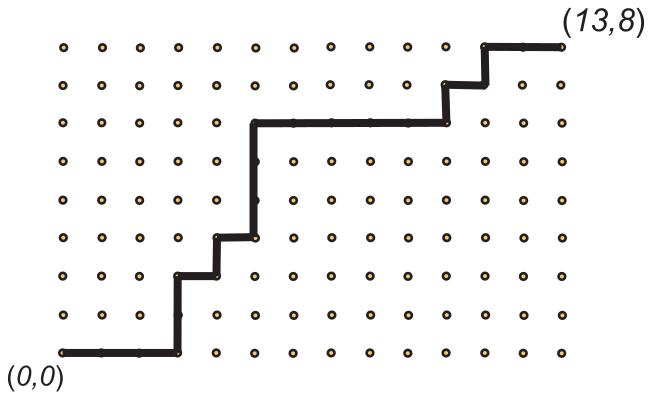
A grid of dots. There are 13 columns of dots and 8 rows of dots. The dot in the lower left corner is labeled \((0,0)\text{.}\) The dot in the upper right corner is labeled \((13,8)\text{.}\) There is a path marked on the grid between these dots. The path moves only to the right and up. It consists of three moves to the right, two moves up, one move right, one move up, one move right, three moves up, five moves right, one move up, one move right, one move up, and two moves right.
The town of Mascotville is laid out as a grid. There are seven parallel streets (\(1^{\text{st}}\) through \(7^{\text{th}}\)) that run north-south and five parallel avenues (\(1^{\text{st}}\) through \(5^{\text{th}}\)) that run east-west.
Buzz starts at the intersection of \(1^{\text{st}}\) Street and \(1^{\text{st}}\) Avenue and wants to get to Bucky’s burrow at the intersection of \(7^{\text{th}}\) Street and \(5^{\text{th}}\) Avenue traveling only on streets/avenues, and always moving toward Bucky’s burrow. How many ways can he do this?
The Varsity is at the intersection of \(3^{\text{rd}}\) Street and \(3^{\text{rd}}\) Avenue. How many ways can Buzz get to Bucky’s burrow if he insists on stopping at The Varsity?
Suppose Buzz is put on a diet and prohibited from eating at The Varsity. He knows if he goes by it, he’ll stop and eat, so he must avoid it completely. How many ways are there for him to get to Bucky’s burrow that avoid The Varsity?
\(4\) factors: \((a_{1}(a_{2}(a_{3}a_{4})))\text{,}\)\((a_{1}((a_{2}a_{3})a_{4}))\text{,}\)\(((a_{1}a_{2})(a_{3}a_{4}))\text{,}\)\(((a_{1}(a_{2}a_{3}))a_{4})\text{,}\) and \((((a_{1}a_{2})a_{3})a_{4})\)
Let \(x_{1},x_{2},\dots,x_{r}\) be nonzero real numbers with \(x_{1} + x_{2} + \cdots + x_{r} \neq 0\text{.}\) Then for every nonnegative integer \(n\text{,}\)