Skip to main content
Contents Embed Prev Up Next \(\newcommand{\set}[1]{\{#1\}}
\newcommand{\ints}{\mathbb{Z}}
\newcommand{\posints}{\mathbb{N}}
\newcommand{\rats}{\mathbb{Q}}
\newcommand{\reals}{\mathbb{R}}
\newcommand{\complexes}{\mathbb{C}}
\newcommand{\twospace}{\mathbb{R}^2}
\newcommand{\threepace}{\mathbb{R}^3}
\newcommand{\dspace}{\mathbb{R}^d}
\newcommand{\nni}{\mathbb{N}_0}
\newcommand{\nonnegints}{\mathbb{N}_0}
\newcommand{\dom}{\operatorname{dom}}
\newcommand{\ran}{\operatorname{ran}}
\newcommand{\prob}{\operatorname{prob}}
\newcommand{\Prob}{\operatorname{Prob}}
\newcommand{\height}{\operatorname{height}}
\newcommand{\width}{\operatorname{width}}
\newcommand{\length}{\operatorname{length}}
\newcommand{\crit}{\operatorname{crit}}
\newcommand{\inc}{\operatorname{inc}}
\newcommand{\HP}{\mathbf{H_P}}
\newcommand{\HCP}{\mathbf{H^c_P}}
\newcommand{\GP}{\mathbf{G_P}}
\newcommand{\GQ}{\mathbf{G_Q}}
\newcommand{\AG}{\mathbf{A_G}}
\newcommand{\GCP}{\mathbf{G^c_P}}
\newcommand{\PXP}{\mathbf{P}=(X,P)}
\newcommand{\QYQ}{\mathbf{Q}=(Y,Q)}
\newcommand{\GVE}{\mathbf{G}=(V,E)}
\newcommand{\HWF}{\mathbf{H}=(W,F)}
\newcommand{\bfC}{\mathbf{C}}
\newcommand{\bfG}{\mathbf{G}}
\newcommand{\bfH}{\mathbf{H}}
\newcommand{\bfF}{\mathbf{F}}
\newcommand{\bfI}{\mathbf{I}}
\newcommand{\bfK}{\mathbf{K}}
\newcommand{\bfP}{\mathbf{P}}
\newcommand{\bfQ}{\mathbf{Q}}
\newcommand{\bfR}{\mathbf{R}}
\newcommand{\bfS}{\mathbf{S}}
\newcommand{\bfT}{\mathbf{T}}
\newcommand{\bfNP}{\mathbf{NP}}
\newcommand{\bftwo}{\mathbf{2}}
\newcommand{\cgA}{\mathcal{A}}
\newcommand{\cgB}{\mathcal{B}}
\newcommand{\cgC}{\mathcal{C}}
\newcommand{\cgD}{\mathcal{D}}
\newcommand{\cgE}{\mathcal{E}}
\newcommand{\cgF}{\mathcal{F}}
\newcommand{\cgG}{\mathcal{G}}
\newcommand{\cgM}{\mathcal{M}}
\newcommand{\cgN}{\mathcal{N}}
\newcommand{\cgP}{\mathcal{P}}
\newcommand{\cgR}{\mathcal{R}}
\newcommand{\cgS}{\mathcal{S}}
\newcommand{\bfn}{\mathbf{n}}
\newcommand{\bfm}{\mathbf{m}}
\newcommand{\bfk}{\mathbf{k}}
\newcommand{\bfs}{\mathbf{s}}
\newcommand{\bijection}{\xrightarrow[\text{onto}]{\text{$1$--$1$}}}
\newcommand{\injection}{\xrightarrow[]{\text{$1$--$1$}}}
\newcommand{\surjection}{\xrightarrow[\text{onto}]{}}
\newcommand{\nin}{\not\in}
\newcommand{\prufer}{\text{prüfer}}
\DeclareMathOperator{\fix}{fix}
\DeclareMathOperator{\stab}{stab}
\DeclareMathOperator{\var}{var}
\newcommand{\inv}{^{-1}}
\newcommand{\ds}{\displaystyle}
\newcommand{\mbf}[1]{\mathbf{#1}}
\newcommand{\mc}[1]{\mathcal{#1}}
\newcommand{\lt}{<}
\newcommand{\gt}{>}
\newcommand{\amp}{&}
\definecolor{fillinmathshade}{gray}{0.9}
\newcommand{\fillinmath}[1]{\mathchoice{\colorbox{fillinmathshade}{$\displaystyle \phantom{\,#1\,}$}}{\colorbox{fillinmathshade}{$\textstyle \phantom{\,#1\,}$}}{\colorbox{fillinmathshade}{$\scriptstyle \phantom{\,#1\,}$}}{\colorbox{fillinmathshade}{$\scriptscriptstyle\phantom{\,#1\,}$}}}
\)
Worksheet 6.3 Interval Representations to Diagrams
Activity 6.3.1 .
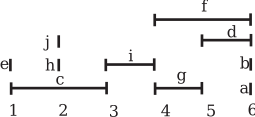
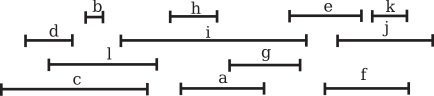
Below are two collections of intervals. For each, draw the order diagram of the interval order represented by these intervals.
(a)
A collection of intervals. The intervals are displayed with a number line that allows identification of the endpoints of the intervals.
\begin{align*}
a \amp = [6,6]\\
b \amp = [6,6]\\
c \amp = [1,3]\\
d \amp = [5,6]\\
e \amp = [1,1]\\
f \amp = [4,6]\\
g \amp = [4,5]\\
h \amp = [2,2]\\
i \amp = [3,4]\\
j \amp = [2,2]
\end{align*}
Solution .
Diagram Exploration Keyboard Controls
Key
Action
Enter, A
Activate keyboard driven exploration
B
Activate menu driven exploration
Escape
Leave exploration mode
Cursor down
Explore next lower level
Cursor up
Explore next upper level
Cursor right
Explore next element on level
Cursor left
Explore previous element on level
X
Toggle expert mode
W
Extra details if available
Space
Repeat speech
M
Activate step magnification
Comma
Activate direct magnification
N
Deactivate magnification
Z
Toggle subtitles
C
Cycle contrast settings
T
Monochrome colours
L
Toggle language (if available)
K
Kill current sound
Y
Stop sound output
O
Start and stop sonification
P
Repeat sonification output
The order diagram of the poset whose interval representation was given. Annotations give cover relations for each of the points.
(b)
A collection of intervals labeled with letters from \(a\) to \(l\text{.}\) The intervals are not displayed with a number line. Using \(\ell(x)\) and \(r(x)\) to denote the left and right endpoints of the interval \(x\text{,}\) respectively, we have the following (strict) ordering of the endpoints
\begin{equation*}
\ell(c) \lt \ell(d) \lt \ell(l) \lt r(d) \lt \ell(b)\lt r(b)\lt \ell(i)\lt r(c)\lt r(l)\lt \ell(h)\lt \ell(a)\lt r(h)\lt \ell(g)\lt r(a)\lt \ell(e)\lt r(g)\lt r(i)\lt \ell(f)\lt \ell(j)\lt r(e)\lt \ell(k)\lt r(f)\lt r(k)\lt r(j)\text{.}
\end{equation*}
Solution .
Diagram Exploration Keyboard Controls
Key
Action
Enter, A
Activate keyboard driven exploration
B
Activate menu driven exploration
Escape
Leave exploration mode
Cursor down
Explore next lower level
Cursor up
Explore next upper level
Cursor right
Explore next element on level
Cursor left
Explore previous element on level
X
Toggle expert mode
W
Extra details if available
Space
Repeat speech
M
Activate step magnification
Comma
Activate direct magnification
N
Deactivate magnification
Z
Toggle subtitles
C
Cycle contrast settings
T
Monochrome colours
L
Toggle language (if available)
K
Kill current sound
Y
Stop sound output
O
Start and stop sonification
P
Repeat sonification output
The order diagram of the poset whose interval representation was given. Annotations give cover relations for each of the points.