Skip to main content
Contents Embed Prev Up Next \(\newcommand{\set}[1]{\{#1\}}
\newcommand{\ints}{\mathbb{Z}}
\newcommand{\posints}{\mathbb{N}}
\newcommand{\rats}{\mathbb{Q}}
\newcommand{\reals}{\mathbb{R}}
\newcommand{\complexes}{\mathbb{C}}
\newcommand{\twospace}{\mathbb{R}^2}
\newcommand{\threepace}{\mathbb{R}^3}
\newcommand{\dspace}{\mathbb{R}^d}
\newcommand{\nni}{\mathbb{N}_0}
\newcommand{\nonnegints}{\mathbb{N}_0}
\newcommand{\dom}{\operatorname{dom}}
\newcommand{\ran}{\operatorname{ran}}
\newcommand{\prob}{\operatorname{prob}}
\newcommand{\Prob}{\operatorname{Prob}}
\newcommand{\height}{\operatorname{height}}
\newcommand{\width}{\operatorname{width}}
\newcommand{\length}{\operatorname{length}}
\newcommand{\crit}{\operatorname{crit}}
\newcommand{\inc}{\operatorname{inc}}
\newcommand{\HP}{\mathbf{H_P}}
\newcommand{\HCP}{\mathbf{H^c_P}}
\newcommand{\GP}{\mathbf{G_P}}
\newcommand{\GQ}{\mathbf{G_Q}}
\newcommand{\AG}{\mathbf{A_G}}
\newcommand{\GCP}{\mathbf{G^c_P}}
\newcommand{\PXP}{\mathbf{P}=(X,P)}
\newcommand{\QYQ}{\mathbf{Q}=(Y,Q)}
\newcommand{\GVE}{\mathbf{G}=(V,E)}
\newcommand{\HWF}{\mathbf{H}=(W,F)}
\newcommand{\bfC}{\mathbf{C}}
\newcommand{\bfG}{\mathbf{G}}
\newcommand{\bfH}{\mathbf{H}}
\newcommand{\bfF}{\mathbf{F}}
\newcommand{\bfI}{\mathbf{I}}
\newcommand{\bfK}{\mathbf{K}}
\newcommand{\bfP}{\mathbf{P}}
\newcommand{\bfQ}{\mathbf{Q}}
\newcommand{\bfR}{\mathbf{R}}
\newcommand{\bfS}{\mathbf{S}}
\newcommand{\bfT}{\mathbf{T}}
\newcommand{\bfNP}{\mathbf{NP}}
\newcommand{\bftwo}{\mathbf{2}}
\newcommand{\cgA}{\mathcal{A}}
\newcommand{\cgB}{\mathcal{B}}
\newcommand{\cgC}{\mathcal{C}}
\newcommand{\cgD}{\mathcal{D}}
\newcommand{\cgE}{\mathcal{E}}
\newcommand{\cgF}{\mathcal{F}}
\newcommand{\cgG}{\mathcal{G}}
\newcommand{\cgM}{\mathcal{M}}
\newcommand{\cgN}{\mathcal{N}}
\newcommand{\cgP}{\mathcal{P}}
\newcommand{\cgR}{\mathcal{R}}
\newcommand{\cgS}{\mathcal{S}}
\newcommand{\bfn}{\mathbf{n}}
\newcommand{\bfm}{\mathbf{m}}
\newcommand{\bfk}{\mathbf{k}}
\newcommand{\bfs}{\mathbf{s}}
\newcommand{\bijection}{\xrightarrow[\text{onto}]{\text{$1$--$1$}}}
\newcommand{\injection}{\xrightarrow[]{\text{$1$--$1$}}}
\newcommand{\surjection}{\xrightarrow[\text{onto}]{}}
\newcommand{\nin}{\not\in}
\newcommand{\prufer}{\text{prüfer}}
\DeclareMathOperator{\fix}{fix}
\DeclareMathOperator{\stab}{stab}
\DeclareMathOperator{\var}{var}
\newcommand{\inv}{^{-1}}
\newcommand{\ds}{\displaystyle}
\newcommand{\mbf}[1]{\mathbf{#1}}
\newcommand{\mc}[1]{\mathcal{#1}}
\newcommand{\lt}{<}
\newcommand{\gt}{>}
\newcommand{\amp}{&}
\definecolor{fillinmathshade}{gray}{0.9}
\newcommand{\fillinmath}[1]{\mathchoice{\colorbox{fillinmathshade}{$\displaystyle \phantom{\,#1\,}$}}{\colorbox{fillinmathshade}{$\textstyle \phantom{\,#1\,}$}}{\colorbox{fillinmathshade}{$\scriptstyle \phantom{\,#1\,}$}}{\colorbox{fillinmathshade}{$\scriptscriptstyle\phantom{\,#1\,}$}}}
\)
Handout 6.3 Linear Extensions and the Subset Lattice
Linear Extensions.
Definition 6.12 .
Let
\(\mbf{P}=(X,P')\) be a poset. A total order
\(L\) on
\(X\) is a
linear extension of
\(P'\) provided that if
\(x \lt y\) in
\(P'\text{,}\) then
\(x \lt y\) in
\(L\text{.}\)
Intuition : A linear extension can’t change the order from
\(P'\text{,}\) but it can put incomparable elements in either way.
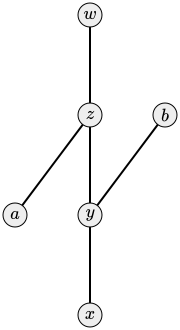
A poset with six points. There is a four-point chain
\(x\lt y\lt z\lt w\) shown centrally. The other cover relations depicted are
\(a\lt z\) and
\(y\lt b\text{.}\)
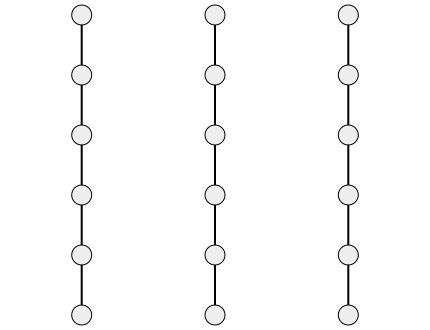
Three linear orderings with six points in each.
When intersecting linear orders to form a poset, the linear orders are linear extensions of the resulting poset.
Sorting problems can be viewed as trying to find a particular linear extension of a poset.
Finding a linear extension of a poset is a common need. Lots of settings require ranked lists. Can we make them fair(-ish)?
The Subset Lattice.
Definition 6.13 .
Let
\(n\) be a positive integer. The
subset lattice \(\bftwo^{n}\) is the poset
\((X,P')\) where
\(X\) is the set of all subsets of
\(\{1,2,\dots,n\}\) and
\(S\leq T\) in
\(P'\) if and only if
\(S\subseteq T\text{.}\)
Peer instruction questions 1–3.